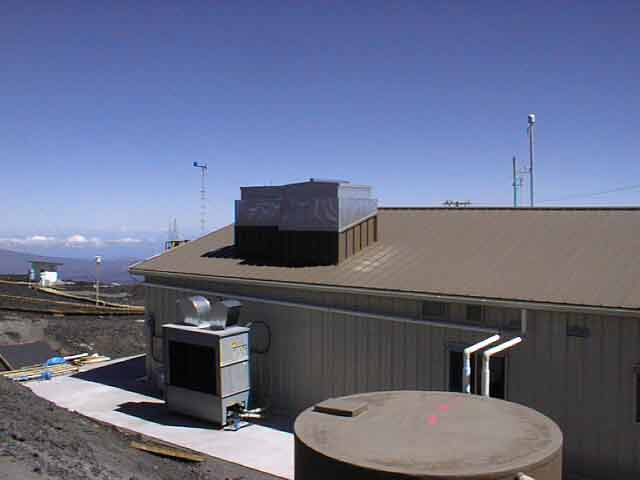
Measurements at the Mauna Loa Observatory stopped after the 2022 eruption of the Mauna Loa volcano, when lava flow crossed the access road and took out power lines to the facility. The observatory remains inaccessible by vehicle and without power from the local utility company.
Observatory staff has established limited solar power in four observatory buildings and restored approximately 33 percent of the measurements onsite, including the Global Monitoring Laboratory and Scripps critical CO2 records and other atmospheric measurements.
Media can contact: Theo Stein (303) 819-7409 (theo.stein@noaa.gov) or Karin Vergoth 303-632-6413 (karin.vergoth@noaa.gov)
 Network For the
Detection of Atmospheric Composition Change (NDACC)
Network For the
Detection of Atmospheric Composition Change (NDACC)
 NASA Jet
Propulsion Laboratory (JPL)
NASA Jet
Propulsion Laboratory (JPL)
Stratospheric Ozone profiles (15-55km),
Stratospheric Temperature profiles (15-80km),
Stratospheric Aerosol profiles (15-40km)
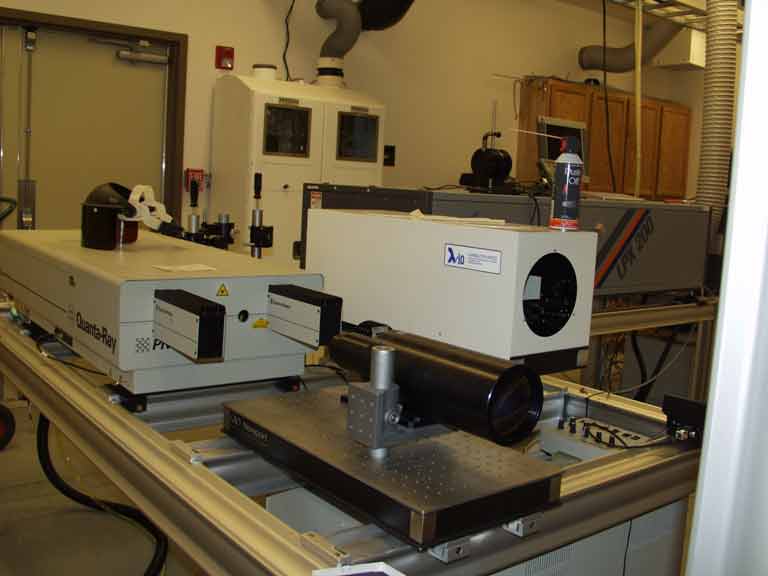
The experiment uses high-power, ultraviolet lasers. The laser wavelengths 308 and 353 nm are transmitted into the atmosphere. Radiation back scattered by the atmosphere at these wavelengths and also at 332 and 385 nm from atmospheric nitrogen Raman scattering is monitored. Ozone is measured by differential absorption lidar (DIAL), temperature by Rayleigh and Raman lidar, and aerosols by elastic backscatter (Mie) lidar. Observations occur 3-4 times per week at MLO.
The primary goals are to make the earliest possible identification of changes in the ozone layer and to discern the causes of the changes; to provide an independent calibration of satellite sensors of the atmosphere, and to obtain data that can be used to test and improve multidimensional stratospheric chemical and dynamical models.
The following discussion and results are taken from a special section of NOAA CMDL Annual Report #27
As Figure 1 shows below, there is a significant positive correlation between ozone that was locally measured by lidar over Mauna Loa Observatory and the potential vorticity from ECMWF observed during the summer of 2002 near the tropopause. The signature of Rossby wave breaking events was easily identified as high PV intrusions over the Hawaiian Islands associated with the high values of ozone measured by lidar.

The MLO location is a strongly active Stratosphere-Troposphere Exchange (STE) region due to the particular configuration of the circulation over the Pacific Ocean at the exit of the Asian monsoon upper circulation.
Dr. Thierry Leblanc
760-249-1070
Dan Walsh
760-249-4958
Dr. John E. Barnes
808-933-6965 (x222)
http://tmf-lidar.jpl.nasa.gov/
1993