3. Aerosols and Radiation
3.1.
Aerosol Monitoring
D. Delene (Editor), E. Andrews, D. Jackson, A. Jefferson, J. Ogren, P.
Sheridan, and J. Wendell
3.1.1. Scientific Background
Aerosol particles affect the radiative balance of Earth both
directly, by scattering and absorbing solar and terrestrial radiation, and
indirectly, through their action as cloud condensation nuclei (CCN) with
subsequent effects on the microphysical and optical properties of clouds. Evaluation of the climate forcing by aerosols,
defined here as the perturbation of the Earth's radiation budget induced by the
presence of airborne particles, requires knowledge of the spatial distribution
of the particles, their optical and cloud-nucleating properties, and suitable
models of radiative transfer and cloud physics.
Obtaining a predictive relationship between the aerosol forcing and the
physical and chemical sources of the particles additionally requires knowledge
of regional and global-scale chemical processes, physical transformation, and
transport models for calculating the spatial distributions of the major
chemical species that control the optical and cloud-nucleating properties of
the particles. Developing and validating
these various models requires a diverse suite of in situ and remote
observations of the aerosol particles on a wide range of spatial and temporal
scales.
Aerosol measurements began at the CMDL baseline observatories in
the mid-1970s as part of the Geophysical Monitoring for Climatic Change (GMCC)
program. The objective of these
"baseline" measurements was to detect a response, or lack of
response, of atmospheric aerosols to changing conditions on a global
scale. Since the inception of the
program, scientific understanding of the behavior of atmospheric aerosols has
improved considerably. One lesson
learned is that residence times of tropospheric aerosols are generally less
than 1 week, and that human activities primarily influence aerosols on
regional/continental scales rather than global scales. In response to this increased understanding,
and to more recent findings that anthropogenic aerosols create a significant
perturbation in the Earth's radiative balance on regional scales [Charlson
et al., 1992; National Research Council, 1996], CMDL expanded its
aerosol research program to include regional aerosol monitoring stations. The goals of this regional-scale monitoring
program are: (1) to characterize means, variabilities, and trends of
climate-forcing properties of different types of aerosols, and (2) to understand
the factors that control these properties.
A primary hypothesis to be tested by NOAA's aerosol research
program is that the climate forcing by anthropogenic sulfate will change in
response to future changes in sulfur emissions.
The forcing is expected to decrease in and downwind of the United States
as a result of emission controls mandated by the Clean Air Act, while continued
economic development in China and other developing countries is expected to
lead to an increased forcing in and downwind of those areas. Testing this hypothesis will require a
coordinated research program involving modeling, monitoring, process, and
closure studies. This report describes
the observations that CMDL is conducting towards this goal.
No single approach to observing the atmospheric aerosol can
provide the necessary data for monitoring all the relevant dimensions and
spatial/temporal scales necessary to evaluate climate forcing by anthropogenic
aerosols. In situ observations from
fixed surface sites, ships, balloons, and aircraft can provide very detailed
characterizations of the atmospheric aerosol but on limited spatial
scales. Remote sensing methods from
satellites, aircraft, or from the surface can determine a limited set of
aerosol properties from local to global spatial scales, but they cannot provide
the chemical information needed for linkage with global chemical models. Fixed ground stations are suitable for
continuous observations over extended time periods but lack vertical
resolution. Aircraft and balloons can
provide the vertical dimension, but not continuously. Only when systematically combined can these
various types of observations produce a data set where point measurements can
be extrapolated with models to large geographical scales where satellite
measurements can be compared to the results of large-scale models, and where
process studies have a context for drawing general conclusions from experiments
conducted under specific conditions.
Measurements of atmospheric aerosols are used in three fundamentally
different ways for aerosol/climate research: algorithm development for models
and remote-sensing retrievals, parameter characterization, and model
validation. Laboratory and field process
studies guide the development of parameterization schemes and the choice of
parameter values for chemical transport models that describe the relationship
between emissions and concentration fields of aerosol species. Systematic surveys and monitoring programs
provide characteristic values of aerosol properties that are used in radiative
transfer models for calculating the radiative effects of the aerosols, and for
retrieving aerosol properties from satellites and other remote sensing
platforms. And finally, monitoring programs
provide spatial and temporal distributions of aerosol properties that are
compared to model results to validate the models. Each of these three modes of interaction
between applications and measurements require different types of data and
entail different measurement strategies.
Ogren [1995] applied the
thermodynamic concept of “intensive” and “extensive” properties of a system to
emphasize the relationship between measurement approach and applications of
aerosol observations.
Intensive properties do not depend on the amount of aerosol present
and are used as parameters in chemical transport and radiative transfer models
(e.g., atmospheric residence time, single-scattering albedo). Extensive properties vary strongly in
response to mixing and removal processes and are most commonly used for model
validation (e.g., mass concentration, optical depth). Intensive properties are more difficult and
expensive to measure than extensive properties because they generally are
defined as the ratio of two extensive properties. As a result, different measurement strategies
are needed for meeting the data needs of the various applications. Measurements of a few carefully chosen
extensive properties, of which aerosol optical depth and species mass
concentrations are prime candidates, are needed in many locations to test the
ability of the models to predict spatial and temporal variations on regional to
global scales and to detect changes in aerosol concentrations resulting from
changes in aerosol sources. The higher
cost of determining intensive properties suggests a strategy of using a limited
number of highly-instrumented sites to characterize means and variabilities of
intensive properties for different regions or aerosol types, supplemented with
surveys by aircraft and ships to characterize the spatial variability of these
parameters. CMDL's regional aerosol
monitoring program is primarily focused on characterizing intensive properties.
CMDL's measurements provide ground truth for satellite
measurements and global models, as well as key aerosol parameters for
global-scale models (e.g., scattering efficiency of sulfate particles and
hemispheric backscattering fraction). An
important aspect of this strategy is that the chemical measurements are linked
to the physical measurements through simultaneous, size-selective sampling that
allows the observed aerosol properties to be connected to the atmospheric
cycles of specific chemical species.
3.1.2. Experimental Methods
Extensive aerosol properties monitored by CMDL include
condensation nucleus (CN) concentration, aerosol optical depth (d),
and components of the aerosol extinction coefficient at one or more wavelengths
(total scattering ssp, backwards
hemispheric scattering sbsp, and
absorption sap). At the regional sites, size-resolved impactor
and filter samples (submicrometer and supermicrometer size fractions) are
obtained for gravimetric and chemical (ion chromatograph) analyses. All size-selective sampling, as well as the
measurements of the components of the aerosol extinction coefficient at the
regional stations, is performed at a low, controlled relative humidity
(<40%) to eliminate confounding effects due to changes in ambient relative
humidity. Data from the continuous
sensors are screened to eliminate contamination from local pollution sources. At the regional stations, the screening
algorithms use measured wind speed, direction, and total particle number
concentration in real-time to prevent contamination of the chemical samples. Algorithms for the baseline stations use
measured wind speed and direction to exclude data that are likely to have been
locally contaminated.
Prior to 1995, data from the baseline stations were manually
edited to remove spikes from local contamination. Since 1995 an automatic editing algorithm has
been applied to the baseline data in addition to manual editing of local
contamination spikes. For the baseline
stations (BRW, Mauna Loa, Hawaii (MLO), American Samoa (SMO), and South Pole,
Antarctica (SPO), as well as Sable Island (WSA)), data are automatically removed
when the wind direction is from local sources of pollution (such as generators
and buildings) as well as when the wind speed is less than a threshold value
(0.5-1 m s-1).
In addition, at MLO data for upslope conditions (1800-1000 UTC) are excluded
since the airmasses do not represent “background” free tropospheric air for
this case. A summary of the data editing criteria is given in Table 3.1.
Integrating nephelometers are used to determine the light
scattering coefficient of the aerosol.
These instruments operate by illuminating a fixed sample volume from the
side and observing the amount of light that is scattered by particles and gas
molecules in the direction of a photomultiplier tube. The instrument integrates over scattering
angles of 7-170°. Depending on the
station, measurements are performed at three or four wavelengths in the visible
and near-infrared. Newer instruments
allow determination of the hemispheric backscattering coefficient by using a
shutter to prevent illumination of the portion of the instrument that yields
scattering angles less than 90°. A
particle filter is inserted periodically into the sample stream to measure the
light scattered by gas molecules; which is subtracted from the total scattered
signal to determine the contribution from the particles alone. The instruments are calibrated by filling the
sample volume with CO2
gas which has a known scattering coefficient.
TABLE 3.1. Data
Editing Summary for NOAA
Baseline and Regional Stations
|
Station
|
Editing
|
Clean Sector
|
|
South Pole
|
a,b,c
|
0° < WD < 110°, 330°<WD
< 360°
|
|
Samoa
|
a,b,c
|
0° < WD < 165°, 285°<WD
< 360°
|
|
Mauna Loa
|
a,b,c,d
|
90° < WD < 270°
|
|
Barrow
|
a,b,c
|
0° < WD < 130°
|
|
Sable Island
|
a,b,c
|
0° < WD < 35°, 85° < WD
< 360°
|
|
Southern Great Plains
|
a
|
|
|
Bondville
|
a
|
|
a: Manual removal
of local contamination spikes;
b: Automatic
removal of data not in clean sector;
c: Automatic
removal of data for low wind speeds;
d: Removal of data
for upslope wind conditions;
WD: Wind
direction.
The aerosol light absorption coefficient is determined with a
continuous light absorption photometer.
This instrument continuously measures the amount of light transmitted
through a quartz filter, while particles are being deposited on the filter. The rate of decrease of transmissivity, divided
by the sample flow rate, is directly proportional to the light absorption
coefficient of the particles. Newer
instruments were calibrated in terms of the difference of light extinction and
scattering in a long-path extinction cell, for laboratory test aerosols. Instruments at the baseline stations
(aethalometers, Magee Scientific, Berkley, California) were calibrated by the
manufacturer in terms of the equivalent amount of black carbon (BC) from which
the light absorption coefficient is calculated assuming a mass absorption
efficiency of the calibration aerosols of 10 m2 g-1.
Particle number concentration is determined with a CN counter
that exposes the particles to a high supersaturation of butanol vapor. This causes the particles to grow to a size
where they can be optically detected and counted. The instruments in use have lower
particle-size detection limits of 10-20 nm diameter.
Summaries of the extensive measurements obtained at each site are
given in Tables 3.2 and 3.3. Table 3.4
lists the intensive aerosol properties that can be determined from the
directly-measured extensive properties.
These properties are used in chemical transport models to determine the
radiative effects of the aerosol concentrations calculated by the models. Inversely, these properties are used by
algorithms for interpreting satellite remote-sensing data to determine aerosol
amounts based on measurements of the radiative effects of the aerosol.
TABLE 3.2. CMDL
Baseline Aerosol Monitoring Stations (Status as of December 1999)
|
Category
|
Baseline Arctic
|
Baseline Free Troposphere
|
Baseline Marine
|
Baseline Antarctic
|
|
Location
|
Point Barrow
|
Mauna Loa
|
American Samoa
|
South Pole
|
|
Designator
|
BRW
|
MLO
|
SMO
|
SPO
|
|
Latitude
|
71.323ºN
|
19.539ºN
|
14.232ºS
|
89.997ºS
|
|
Longitude
|
156.609ºW
|
155.578ºW
|
170.563ºW
|
102.0ºE
|
|
Elevation (m)
|
8
|
3397
|
77
|
2838
|
|
Responsible Institute
|
CMDL
|
CMDL
|
CMDL
|
CMDL
|
|
Status
|
Operational 1976.
Major upgrade 1997.
|
Operational 1974
|
Operational, 1977
|
Operational, 1974
|
|
Sample RH
|
RH <40%
|
Uncontrolled
|
Uncontrolled
|
Uncontrolled
|
|
Sample Size Fractions
|
D<1 µm
D<10 µm
|
Uncontrolled
|
Uncontrolled
|
Uncontrolled
|
|
Optical measurements
|
ssp(3l), sbsp(3l), sap(1l)
|
ssp(3l), sap(1l), d(6l)
|
none
|
ssp(4l)
|
|
Microphysical
measurements
|
CN concentration
|
CN concentration
|
CN concentration
|
CN concentration
|
|
Chemical measurements
|
Major ions, mass
|
None
|
None
|
None
|
TABLE 3.3. CMDL
Regional Aerosol Monitoring Sites (Status as of December 1999)
|
Category
|
Perturbed Marine
|
Perturbed Continental
|
Perturbed Continental
|
|
Location
|
Sable Island, Nova Scotia,
Canada
|
Bondville, Illinois
|
Lamont, Oklahoma
|
|
Designator
|
WSA
|
BND
|
SGP
|
|
Latitude
|
43.933ºN
|
40.053ºN
|
36.605ºN
|
|
Longitude
|
60.007ºW
|
88.372ºW
|
97.489ºW
|
|
Elevation (m)
|
5
|
230
|
315
|
|
Responsible Institute
|
CMDL
|
CMDL
|
CMDL
|
|
Collaborating Institute
|
AES Canada, NOAA/PMEL
|
University of Illinois,
Illinois State Water Survey
|
DOE/ARM
|
|
Status
|
Operational, August 1992
|
Operational, July 1994
|
Operational, July 1996
|
|
Sample RH
|
RH <40%
|
RH <40%
|
RH <40%
|
|
Sample Size Fractions
|
D<1 µm, D<10 µm
|
D<1 µm, D<10 µm
|
D<1 µm, D<10 µm
|
|
Optical measurements
|
ssp(3l), sbsp(3l) sap(1l)
|
ssp(3l), sbsp(3l), sap(1l)
|
ssp(3l),sbsp(3l), sap(1l), d(7l)
|
|
Microphysical
measurements
|
CN concentration
|
CN concentration
|
CN, n(D) concentration
|
|
Chemical measurements
|
Major ions, mass
|
Major ions, mass
|
None
|
TABLE 3.4. Intensive
Aerosol Properties Derived From CMDL Network
|
Properties
|
Description
|
|
å
|
The Ångström exponent, defined
by the power-law sspµl-å, describes the
wavelength-dependence of scattered light.
In the figures
below, å is calculated from measurements
at 550 and 700 nm wavelength.
Situations where the scattering is dominated by submicrometer
particles typically have values around 2, while values close to 0 occur when
the scattering is dominated by particles larger than a few microns in diameter.
|
|
wo
|
The aerosol single-scattering
albedo, defined as ssp/(sap + ssp),
describes the relative contributions of scattering and absorption to the
total light extinction. Purely
scattering aerosols (e.g., sulfuric acid) have values of 1, while very strong
absorbers (e.g., elemental carbon) have values around 0.3.
|
|
g, b
|
Radiative transfer models
commonly require one of two integral properties of the angular distribution
of scattered light (phase function):
the asymmetry factor g or
the hemispheric backscatter fraction b. The asymmetry factor is the cosine-weighted
average of the phase function, ranging from a value of -1 for entirely
backscattered light to +1 for entirely forward-scattered light. The hemispheric backscatter fraction b is defined as sbsp/ssp.
|
|
ai
|
The mass scattering efficiency
for species i, defined as the slope
of the linear regression line relating ssp and the mass
concentration of the chemical species, is used in chemical transport models
to evaluate the radiative effects of each chemical species prognosed by the
model. This parameter has typical
units of m2 g-1.
|
3.1.3. Annual Cycles
The annual cycles of aerosol optical properties for the four
baseline and three regional stations are illustrated in Figure 3.1 and Figure
3.2. The data are presented in the form
of box and whisker plots that summarize the distribution of values. Each box ranges from the lower to upper
quartiles with a central bar at the median value, while the whiskers extend to
the 5th and 95th percentiles. The
statistics are based on hourly averages of each parameter for each month of the
year, also shown are the annual statistics for the entire period of
record. A horizontal line is given that
intersects the annual median so measurements above and below the median can be
easily discerned.
In general, changes in long-range transport patterns dominate the
annual cycles of the baseline stations.
For BRW, the highest values of CN, ssp,
and sap are observed during
the spring arctic haze period when anti-cyclonic activity transports pollution
from the lower latitudes of Central Europe and Russia. A more stable polar front characterizes the
summertime meteorology. High cloud coverage
and precipitation scavenging of accumulation mode (0.1-1.0 mm
diameter) aerosols account for the annual minima in ssp and sap
from June to September. In contrast, CN
values have a secondary maximum in the late summer which is thought to be the
result of sulfate aerosol production from gas to particle conversion of DMS
oxidation products from local oceanic emissions [Radke et al.,
1990]. The aerosol single-scattering
albedo displays little annual variability, which is indicative of highly
scattering sulfate and seasalt aerosol.
A September minimum is observed in å when ssp
and accumulation mode aerosols are also low but when primary production of
coarse mode seasalt aerosols from open water is high.
For MLO, the highest ssp and sap values occur in the
springtime and result from the long-range transport of pollution and mineral
dust from Asia. However, little seasonality is seen in CN concentrations at
MLO, indicating that the smallest particles (<0.1 mm diameter), which usually
dominate CN concentration, are not enriched during these long-range transport
events. Both the aerosol ssp and Ångström
exponent display seasonal cycles at SPO with a ssp
maximum and an å minimum in winter associated with the transport of coarse mode
seasalt from the Antarctic coast to the interior of the continent. The summertime peaks in CN and å are
associated with fine mode sulfate aerosol and correlate with a seasonal sulfate
peak found in the ice core presumably from coastal biogenic sources [Bergin
et al., 1998]. The aerosol extensive
properties at SMO display no distinct seasonal variation. Albedo values above one that are evident at
BRW and MLO are due to instrument noise at low aerosol concentration. These high albedo values are not present in
daily averaged data. Furthermore, these
high albedo value go away if you exclude data where ssp is below 1 Mm-1. Hence, the high albedo values result from a
instrument detection limitation problem.
Based on only 4-7 years of measurements, the annual cycles for
the regional stations are less certain than those of the baseline stations. The
proximity of the regional sites to North American pollution sources is apparent
in the results, with a monthly median values of ssp that is nearly two orders of magnitude higher than
values from the baseline stations. The Bondville site (BND), situated in a
rural agricultural region, displays autumn highs in sap and a low in wo which coincide with
anthropogenic and dust aerosols emitted during the harvest. As evident in the lower ssp and sap values, the
Southern Great Plains site (SGP) is more remote than BND. SGP has a similar but less pronounced annual
cycle with late summer highs in ssp and sap, and a
corresponding minimum in wo. Little seasonal variability is observed in
aerosol properties at WSA. Values of å tend to be higher in the summer and
likely result from transport of fine mode sulfate aerosol from the continent
and lower coarse-mode production of particles with lower summer wind speeds.
3.1.4.
Long-term Trends
Long-term trends in CN
concentration, ssp, sap, w0, and å
are plotted in Figure 3.3 for the baseline observatories. The monthly means are plotted along with a
linear trend line fitted to the data.
The aerosol properties at BRW exhibit an annual decrease in ssp of about 2% per year since 1980. This reduction in aerosol scattering has been
attributed to decreased anthropogenic emissions from Europe and Russia [Bodhaine, 1989] and is most apparent
during March when the Arctic haze effect is largest. The corresponding decrease in the Ångström
exponent over the same time period points to a shift in the aerosol size
distribution to a larger fraction of coarse mode seasalt aerosol. Stone
[1997] noted a long-term increase in surface temperatures and cloud coverage at
BRW from 1965-1995 which derive from changing circulation patterns and may
account for the reduction in ssp
by enhanced scavenging of accumulation mode aerosols.
In contrast to the reduction in ssp at BRW, CN con-centrations, which are most sensitive to
particles with diameters <0.1 mm,
have increased since 1976. There seems
to be an offset in CN concentration starting in 1998 which corresponds to a
change to a new CN sampling inlet. A
step increase in late 1991 dominates the trend in CN concentration at MLO. The step increase in CN at SPO in 1989 is due
to replacement of the CN counter with a butanol-based instrument with a lower
size detection limit. The reason for the
decrease in CN and increase in å at
SMO is not readily apparent, but it could stem from changes in long-term
circulation patterns.
Previous reports describing the aerosol data sets include: BRW: Bodhaine [1989, 1995]; Quakenbush and Bodhaine [1986]; Bodhaine and Dutton [1993]; Barrie [1996]; MLO: Bodhaine [1995]; SMO: Bodhaine
and
DeLuisi [1985]; SPO: Bodhaine et al. [1986, 1987, 1992]; Bergin et al. [1998]; WSA: McInnes et al. [1998].


Fig. 3.1. Annual cycles for baseline stations at BRW,
MLO, SMO, and SPO showing hourly statistics for condensation nuclei (CN)
concentration, total scattering coefficient (ssp), Ångström exponent (å),
absorption coefficient (sap) and
single-scattering albedo (wo). Statistics representing the entire period are
given in the last column (ANN), with the horizontal line intersecting the
median value.

Fig. 3.2. Annual cycles
for regional stations at Bondville, Illinois (BND), Sable Island, Nova Scotia
(WSA), and Lamont, Oklahoma (SGP)
showing hourly statistics of absorption coefficient (sap), total scattering
coefficient (ssp),
Ångström exponent (å), and single-scattering albedo (wo). Statistics representing the entire period are
given in the last column (ANN), with the horizontal line intersecting the
median value.
Fig. 3.3. Long-term
trends for baseline stations showing monthly averaged condensation nuclei
concentration, total scattering coefficient at 550 nm, Ångström
exponent (550/700 nm), absorption coefficient and single-scattering
albedo. A simple linear fit to the data
is given by the horizontal line.
Fig. 3.3 (Continued).
Long-term trends for baseline stations showing monthly averaged
condensation nuclei concentration, total scattering coefficient at 550 nm,
Ångström exponent (550/700 nm), absorption coefficient and
single-scattering albedo. A simple
linear fit to the data is given by the horizontal line.
3.1.5. Special Studies
Comparison of Aerosol Light Scattering and Absorption Measurements at
Barrow, Alaska From October, 1997 to October, 1999
NOAA’s Climate Monitoring and Diagnostics Lab (CMDL) has measured
both aerosol light scattering (since 1976) and aerosol light absorption (since
1988) at Barrow, Alaska (BRW). To obtain
data representative of clean baseline conditions, measurements from the
polluted sector, defined by wind speed and direction, are automatically removed
from the data set. Table 3.5 lists the
instruments and their period of operation at Barrow. Initially, light scattering was measured
using a 4 wavelength nephelometer and light absorption was measured using an
aethalometer. This original sampling
system did not include size or relative humidity control of the aerosol
sample. In the fall of 1997 new light
scattering and absorption instruments were installed at Barrow (within 2 meters
of the old instruments). The new
instruments are designated NSA (for North Slope, Alaska) to distinguish them
from the co-located BRW instruments. The
new system obtains measurements at two size cuts by using a valve to switch between
a 10 mm and
1 mm
impactor. Relative humidity is
maintained at or below 40% by heating the air sample. The BRW and NSA systems were operated
simultaneously for approximately 1 year (Fall, 1997 – Fall, 1998). One year of simultaneous light scattering
measurements and two years of light absorption measurements from the co-located
instruments are compared. It is
important to understand how measurements from these instruments compare in
order to maintain data consistency for the entire measurement period.
The comparison procedure was:
·
Select data for the overlap period October, 1997
to October, 1998 for ssp; October, 1997 to October, 1999 for sap.
·
Estimate the absorption coefficient for the
aethalometer using: sap
= 10 m2/g * [BC]
·
Apply quality control edit corrections to data
sets (e.g., remove spikes and contaminated data)
·
For the NSA data set, use only 10 mm
size cut data.
·
Correct the NSA PSAP data for: (a) scattering by
particles within the filter and (b) spot size.
Also, remove low transmittance data (e.g. transmittance < 0.5 as per
[Bond et al.,1999]
·
Calculate hourly averages of scattering and
absorption coefficients
·
Calculate daily averages of absorption for the
aethalometer and PSAP
·
Remove obvious outliers (four points for the sap data).
·
Determine the least squares linear fit and
correlation coefficient for the data sets.
Perform the regression for both a calculated and forced-to-zero
y-intercept.
Figure 3.4 shows that, for the two years, on an hourly basis,
there is a relatively low correlation between the PSAP and aethalometer
measurements (R2=0.70) although the instruments agree fairly well –
the slope is 0.94. Looking at the data
on a year-by-year basis, we see that the two instruments demonstrated better
agreement with each other for the second year period than for the first
year (slope = 0. 99, R2=0.77). This difference is statistically significant
but it’s unclear what caused this difference.

Fig. 3.4 Comparison of hourly-averaged absorption data from NSA and
BRW.
For daily-averaged data (Figure 3.5), there is a stronger
relationship between the two instruments’ measurements than for hourly averaged
data and, again, good agreement for the two measurements of absorption
coefficient. Because particle concentrations and hence, light absorption, are
low at the site, often near the detection limits of the two instruments, there
is considerable noise in the measurements.
The improvement in fit for the daily averaged values with respect to the
hourly averaged values is most likely a result of averaging noise in the data
over a longer time period.

Fig. 3.5 Comparison of
daily-averaged absorption data from NSA and BRW.
Figure 3.6 shows the variability in the ratio of the two
instrument measurements as a function of absorption coefficient. The relationship between the two instruments
appears less variable at higher absorption coefficients (sap
> 1 Mm-1) but only about 10% of the data are in this range. It is unfortunate that the polluted data are
not recorded so that we could compare the instrument responses at higher
particle concentrations. At low
absorption values (sap < 1 Mm-1) there is
considerable variability due to instrument noise. Interestingly, while the aethalometer data
are lower than PSAP data for high absorption coefficients (consistent with the
linear fit results) the aethalometer measurements tend to be lower than the
PSAP’s at low sap.

Fig. 3.6 Variation in
the ratio of absorption measured at BRW to that measured at NSA as a function
of absorption coefficient.
Table 3.6 summarizes the fit parameters for the absorption
coefficient. Overall, the linear fits
suggest that the BRW measurements were consistently lower than the NSA
measurements. There are other
questions which should be addressed with respect to measurements of sap
at Barrow. These include: How much do
the differences in wavelength of the two instruments influence sap? Is some of the variability in the two
instruments due to differences in polluted sector data removal – does the NSA
system the use same wind data as the BRW system? Are there corrections which
should be applied to the aethalometer: for example some sort of spot size
correction? How appropriate is the
arbitrarily chosen 10 m2/g which used to convert from mass
concentrations measured by the aethalometer into scattering coefficients?
In addition to comparing absorption coefficient measurements,
comparisons of scattering coefficient as a function of wavelength for the BRW
and NSA nephelometers were also made for a one year period starting October,
1997. Table 3-7 summarizes results for
the scattering coefficient comparison.
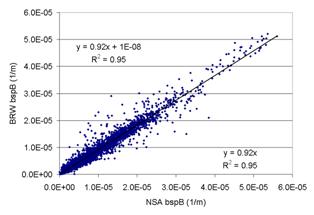
For the two nephelometers there is high correlation, despite low
particle concentrations and hence low scattering measurements. The blue scattering coefficients show the
largest discrepancy. This may be due to
problems with the blue photo-multiplier in the BRW nephelometer. The blue scattering measurement at BRW was
often similar to or even lower than the green scattering measurement, while at
NSA the sspB
/sspG
ratio was typically greater than 1 as expected (see Figure 3.7 a,b,c).
Differences between the two instruments may be attributable to
several factors. Optically, the two
nephelometers are (almost) identical, so it was assumed that correcting for
truncation angle would not improve the comparison, thus for this comparison no
corrections for truncation were applied to either instrument. Changes in filter bandpass and calibration
error may also play a role.
a)
b)

c)

Fig. 3.7 Comparison of
hourly averaged scattering coefficients measured at BRW and NSA for blue (450
nm) green (550 nm) and red (700 nm) wavelengths.
a) 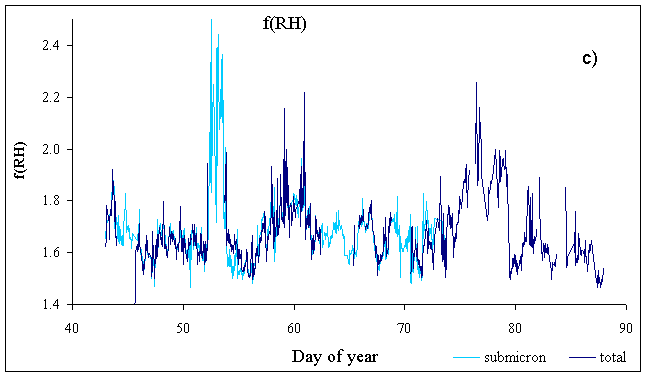
|
|
Optical Property of Indian Ocean Aerosols
During February and March of 1999 the CMDL aerosol group
participated in the Indian Ocean Experiment (INDOEX), a multi-platform field
campaign that took place over the Indian Ocean.
A central focus of the campaign was to assess the role of aerosols from
the Indian subcontinent on direct and indirect radiative forcing as well as the
role of convective cirrus in aerosol transport and photochemical processing.
b)
|
|
This region of the world has a fast growing population that is
becoming more industrialized with emissions of CO2, aerosols and
sulfates expected soon to surpass those of North America and Europe. Because of
these potentially high future emissions, an understanding of climate forcing
and transport of trace gases and aerosols in this region is critical to being
able to predict global climate forcing.
c)
|
|
The INDOEX campaign was based at the Maldive Islands, which is
about 700 km southwest of India. As part of the campaign NOAA/CMDL performed
direct measurements of aerosol optical properties on two separate platforms;
the U.C. San Diego - Scripps climate observatory on the island of Kaashidhoo
(KCO) and on-board the NCAR C-130 aircraft. These measurements include the
aerosol total and hemispheric backscattering coefficients, the aerosol
hygroscopic growth factor (f(RH)), and the aerosol absorption
coefficient. Here we define the aerosol hygroscopic growth factor to be the
ratio of aerosol scattering coefficients at 85% relative humidity to aerosol
scattering coefficient at 40% relative humidity.
Aerosol optical measurements operated at KCO from February 12 to
March 28, 1999. During the northeast monsoon season (January-April) the
Intertropical Convergence Zone is south of the island and air circulation is
from the Indian subcontinent. Thus, aerosols measured at KCO during this time
represent polluted continental air masses. Figure 3.8 shows a time series of
the measured aerosol optical properties at KCO.
Back trajectory calculations show a change in the air mass origin
on March 7th (Day 66) from the east Bay of Bengal region to the west
Arabian Sea. Evidence of this change is
apparent in a decreased aerosol loading and accompanied by lower ssp
and sap values. Despite this difference in aerosol
loading, the aerosol intensive properties of single-scattering albedo,
backscatter fraction and hygroscopic growth are similar between the two regions. The lower aerosol loading in the Arabian Sea
air masses likely resulted in a larger contribution to the total scattering
from supermicron sea salt particles as evident in the smaller fractions of
submicron aerosol scattering and absorption from the Arabian Sea.
Table 3.8 lists the mean values of the measured parameters and
compares them to those from other CMDL surface sites. In comparison to aerosol properties measured
at Bondville (a US continental site) and Sable Island (an Canadian marine site)
the aerosol from the Indian subcontinent has a far greater absorption
coefficient and lower single-scattering albedo.
Unlike aerosols from U.S. continental sites, the single scattering
albedo at KCO declines with an increase in aerosol loading (Figure 3.9). Apparently, under highly polluted conditions
the aerosol soot fraction relative to sulfate is higher than that from US
sites. This difference could reflect the
regional sources of sulfate and carbon as well as rates of in-cloud sulfate
oxidation. Although the Indian
subcontinent aerosol has a large absorbing fraction, its mean hygroscopic
growth is similar to that from regions with less absorbing aerosol. This difference points to either a
significantly different composition or morphology for the absorbing components
of aerosols from the Indian subcontinent with respect to North America.


Fig. 3.8 Time series
of measurements from KCO a) aerosol
total and submicron scattering and absorption b) aerosol total and submicron
single scattering albedo c) aerosol total and submicron hygroscopic
growth. Al,l values are reported for
mid-visible (green) wavelengths.
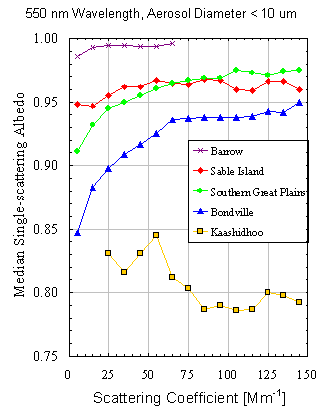
Fig.
3.9 Aerosol single-scattering albedo
plotted against scattering coefficient (hourly average data). Data are from the four CMDL North American
monitoring stations (entire period of record) and the Kaashidhoo Island station
in the Indian Ocean (February & March 1999).
In addition to surface-based measurements at KCO, aerosol optical
properties were measured in situ from the NCAR C-130 research aircraft using an
aircraft version of the ground-based CMDL aerosol measurement system. Aircraft measurements were necessary for
information on spatial (i.e., horizontal and vertical) and temporal variability
of aerosol optical properties. Vertical
profiles and horizontal legs at altitude were conducted to characterize aerosol
variability in the region, with coverage of much of the Indian Ocean Basin
between 8° S and 17° N.
The measured aerosol light scattering coefficients over the
northern Indian Ocean were typically several times those observed at perturbed
continental sites in the U.S. The
aerosol was also substantially darker than U.S. sites, with an average
single-scattering albedo for all flights near 0.85. The highest aerosol concentrations were
observed in the northern Indian Ocean (north of the Maldives). Typical aerosol optical depths in the region,
calculated using aircraft aerosol optical property data, were in the 0.15-0.35
range for most days. Elevated aerosol
layers, decoupled from the surface, were observed in over 1/3 of the vertical
profiles. Figure 3.10 shows two vertical
profiles, with one showing the elevated aerosol layer.
TABLE 3.5 Description of instrumentation at Barrow, Alaska
|
Instrument
|
Period of Operation
|
Station
|
Comments
|
|
MRI nephelometer.
|
1976- Fall, 1998
|
BRW
|
4 wavelength, no size cut
|
|
Magee Scientific Aethalometer
|
1988 – present
|
BRW
|
broadband, no size cut
Specific absorption of 10 m2/g used to convert
[BC] to ap
|
|
TSI Nephelometer (Model# 3563)
|
Fall, 1997-present
|
NSA
|
3 wavelength, 1
and 10 mm size cut
|
|
Radiance Research
Particle soot absorption photometer (PSAP)
|
Fall, 1997-present
|
NSA
|
565 nm wavelength,1 and 10 mm size cut
|
TABLE 3.6 Results from linear fits of data to equation: BRW
= m*NSA for absorption coefficient
|
Parameter
|
Slope
|
R2
|
Number of points
|
|
sap (hourly)Year 1
|
0.92+
0.01
|
0.66+
0.01
|
3456
|
|
sap (hourly)Year 2
|
0.99+
0.01
|
0.77+
0.01
|
3562
|
|
sap (hourly)both years
|
0.94+
0.01
|
0.70+
0.01
|
7018
|
|
sap
(daily)Year 1
|
0.94+
0.03
|
0.88+
0.02
|
223
|
|
sap (daily)Year 2
|
1.03+
0.03
|
0.87+
0.02
|
226
|
|
sap
(daily) both years
|
0.96+
0.02
|
0.89+
0.01
|
449
|
Table 3.7 Results
from linear fits of data to equation: BRW = m*NSA for scattering coefficient
|
Parameter
|
Slope
|
R2
|
Number of
points
|
|
sspB
|
0.92+
0.00
|
0.95+
0.01
|
3456
|
|
sspG
|
1.00+
0.00
|
0.94+
0.01
|
3456
|
|
sspR
|
0.97+
0.00
|
0.94+
0.01
|
3456
|
Table 3.8 Means and
variabilities of pollution aerosols. Scattering coefficients, s
sp are for l = 550 nm. Absorption
coefficients are at l = 565 nm. FsspG
and Fs ap are the submicron fractions of aerosol
scattering and absorption, respectively. f(RH) is given for a relative
humidity of 85% relative to 40%. Variabilities are reported as +/- one standard
deviation. Sable Island, Nova Scotia and Bondville Illinois are
anthropogenically perturbed marine and continental sites, respectively. The
range of f(RH) at Sable Island is
between polluted and clean air masses observed over a ~10 day period. Time
periods of 4 hours before and after rain events were excluded from the KCO
data.
|
Aerosol Property
|
Bay of Bengal
|
Arabian Sea
|
Sable Island
|
Bondville
|
|
ssp
|
95+20
|
54+9
|
42+35
|
60+49
|
|
s
ap
|
25+7
|
10+3
|
2+2
|
5+4
|
|
F sspG
|
0.70+0.06
|
0.62+0.05
|
0.26+0.10
|
0.86+0.07
|
|
F s
ap
|
0.85+0.04
|
0.80+0.07
|
0.81+0.10
|
0.82+0.10
|
|
f(RH)
|
1.65+0.10
|
1.67+0.14
|
1.7 + 2.7*
|
1.5+0.4**
|
*McInnes et al., 1998. **Koloutsou-Vakakis
et al., 1999

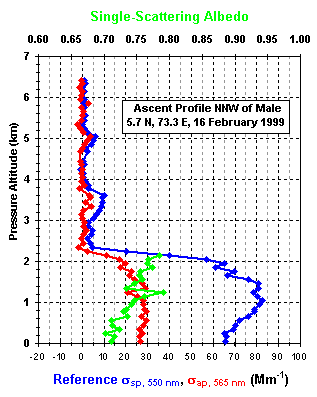
Fig. 3.9. Two
vertical profiles of aerosol optical properties obtained by CMDL instruments
onboard the NCAR C-130 aircraft. Profile
on the left shows a thick aerosol layer from the surface to ~2 km. Profile on the right shows an elevated
aerosol layer with a peak at ~3 km altitude.
References
Barrie, L.
A., Occurrence and trends of pollution in the Arctic troposphere, in Chemical Exchange Between the Atmosphere and
Snow, Edited by E. W. Wolff and R. C. Bales, Springer-Verlag,
Berlin, 1996.
Bergin,
M.H., S.E. Schwartz, J.A. Ogren, and L.M. McInnes, Evaporation of ammonium
nitrate aerosol in a heated nephelometer:
Implications for field measurements, Environ. Sci. Technol., 31,
2878-2883, 1997.
Bergin, M.H., R.S. Halthorne, S.E. Schwartz, J.A.
Ogren, and S. Nemesure, Comparison of aerosol column properties based on
nephelometer and radiometer measurements at the SGP ARM site, J. Geophys.
Res., 105,6807-6818, 2000.
Bergin,
M.H., Meyerson, E., Dibb, J.E., Mayewski, P., Comparison of continuous aerosol
measurements and ice core chemistry over a 10 year period at the South Pole, Geophys. Res. Lett., in press, 1998.
Bodhaine,
B. A., Barrow surface aerosol: 1976-1987, Atmos.
Environ., 23(11), 2357-2369, 1989.
Bodhaine,
B. A., Aerosol absorption measurements at Barrow, Mauna Loa and South Pole, J. Geophys. Res., 100, 8967-8975, 1995.
Bodhaine,
B. A., and E. G. Dutton, A long-term decrease in Arctic Haze at Barrow, Alaska,
Geophys. Res. Lett., 20, 947-950,
1993.
Bodhaine,
B. A. and J.J. DeLuisi, An aerosol
climatology of Samoa, J. Atmos. Chem.,
3, 107-122, 1985.
Bodhaine,
B. A., J. J. DeLuisi, J. M. Harris, P. Houmere, and S. Bauman, Aerosol
measurements at the South Pole, Tellus,
38B, 223-235, 1986.
Bodhaine,
B. A., J.J. De Luisi, J. M. Harris, P. Houmere, and S. Bauman, PIXE analysis of
South Pole aerosol, in Nuclear
Instruments and Methods in Physics Research, B22, pp. 241-247, Elsevier,
Holland, 1987.
Bodhaine,
B.A., Harris, J.M., Ogren, J.A., Aerosol optical properties at Mauna Loa
Obseratory: Long-range transport from Kuwait?, Geophys. Res. Lett., 19, 581, 1992.
Bond,
T.C., T.L. Anderson and D. Campbell, Calibration and intercomparison of
filter-based measurements of visible light absorption by aerosols, Aerosol
Sci. Technol., 30, 582-600, 1999
Koloutsou-Vakakis,
S., C.M. Carrico, M.J. Rood, Z. Li, R.Shrestha, J.A. Ogren, J.C. Chow, and J.G.
Watson, Aerosol properties at a
mid-latitude northern hemisphere continental site, submitted to J. Geophys. Res., 1999.
Charlson,
R.J., S.E. Schwartz, J.M. Hales, R.D. Cess, J.A. Coakley, Jr., J.E. Hansen, and
D.J. Hofmann, Climate forcing by anthropogenic aerosols, Science, 255,
423-430, 1992.
McInnes,
L.M., Bergin, M.H., Ogren, J.A., Schwartz, S.E., Differences in hygroscopic
growth between marine and anthropogenic aerosols, Geophys.
Res. Lett., 25(4), 513-516, 1998.
NRC
(National Research Council), Aerosol Radiative Forcing and Climatic Change,
National Academy Press, Washington, D.C., 161 pp, 1996.
Ogren,
J.A., "A systematic approach to in situ observations of aerosol
properties", In Aerosol Forcing of Climate, edited by R.J. Charlson
and J. Heintzenberg, John Wiley & Sons, Ltd., 215-226, 1995.
Quakenbush,
T. K., and B. A. Bodhaine, Surface aerosols at the Barrow GMCC observatory:
Data from 1976 through 1985, NOAA Data Rep. ERL ARL-10, 230 pp., NOAA Air Resources Laboratory, Silver Spring,
MD, 1986.
Radke, L.
F., C.A. Brock, R.J. Ferek, and D.J. Coffman, Summertime Arctic hazes, paper
A52B-03 presented at the American
Geophysical Union Fall Annual Meeting, San Francisco, December 3-7, 1990.
Stone,
R.S., Variations in western Arctic temperatures in response to cloud radiative
and synoptic-scale influences. J.
Geophys. Res., 102(D18), 21769-21776, 1997.