Aircraft Plume Study

Where: Los Angeles International Airport (LAX)
When: May 2001
Who: Investigators in this project include researchers from CSD (formerly the Environmental Technology Laboratory Optical Remote Sensing Division). This project was in collaboration with the U.S. Department of Transportation and the University of Central Florida.
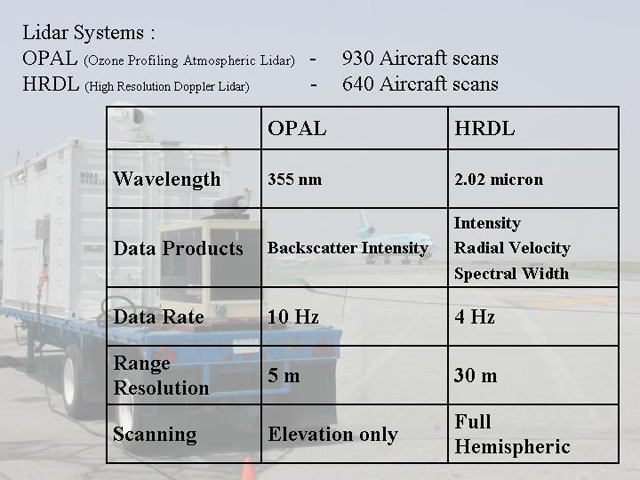
How: Lidars examine dispersion of jet engine exhaust. This project deployed the Ozone Profiling Atmospheric Lidar (OPAL) and the High Resolution Doppler Lidar (HRDL) instruments.
Researchers use lidar to solve one more piece of the air quality puzzle. Pollution in the exhaust from jet aircraft taxiing and taking off at an airport is a concern for its neighbors. Air quality models failed to predict the concentrations correctly, because the initial rise of the hot, dynamic jet plumes is unknown.
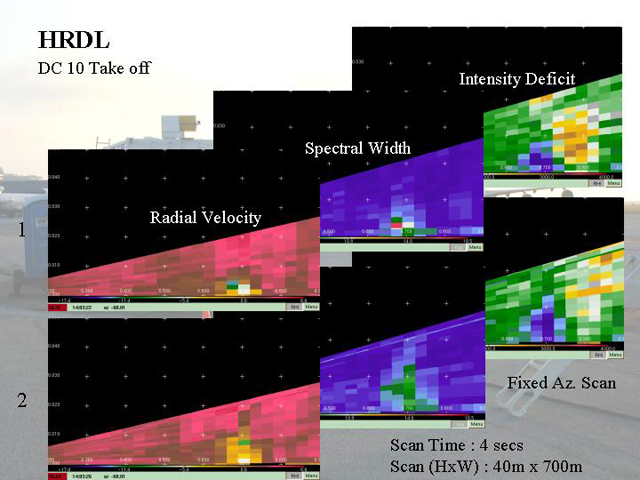
Scanning lidars (or laser radars) with eyesafe, invisible beams were used to observe the plume location and size behind individual airplanes. Many types of aircraft were studied under varied meteorological conditions during May 17-24, 2001. The lidar usually detected enhanced backscatter due to additional particles generated by the engines. In very humid conditions, on the other hand, a deficit of particles was sometimes detected. Presumably this was because drying of the ambient particles by the hot engine exhaust was stronger than the creation of new particles. One of the lidars also used Doppler measurements to determine the background wind profile and detect the dynamic jets of air from aircraft. The perturbations in backscatter and airflow are used as tracers of the spatio-temporal evolution of the jet exhaust plumes.
Data are analyzed to provide the correct spatial source information for input into standard air quality dispersion models.